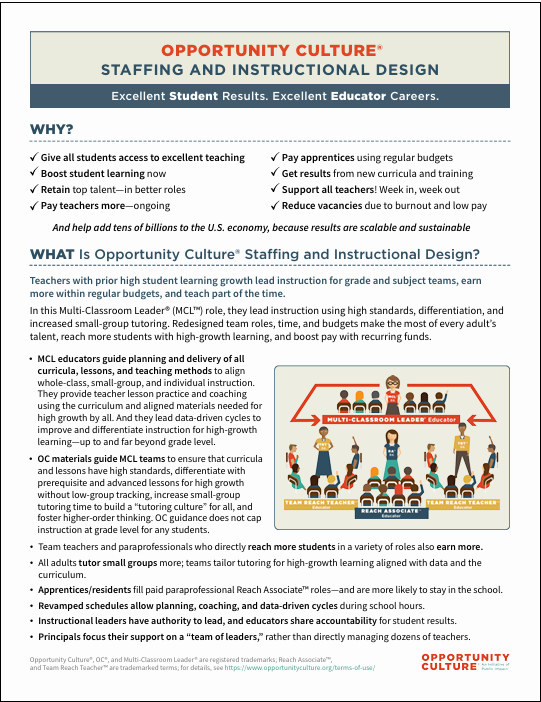
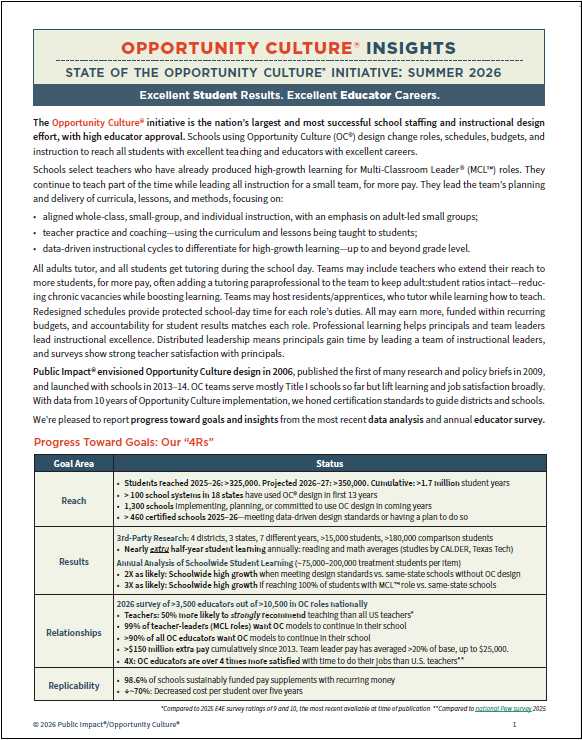
Public Impact® committed to four bottom-line measures two decades ago: reaching large number of students, measuring results primarily in student learning growth, creating strong professional relationships and satisfaction for educators, and ensuring financial replicability of approaches (our “4Rs”). In these companion briefs and educator checklist, we take stock in summer 2026 of the Opportunity Culture® initiative, the nation’s largest and most successful school staffing and instructional design effort.
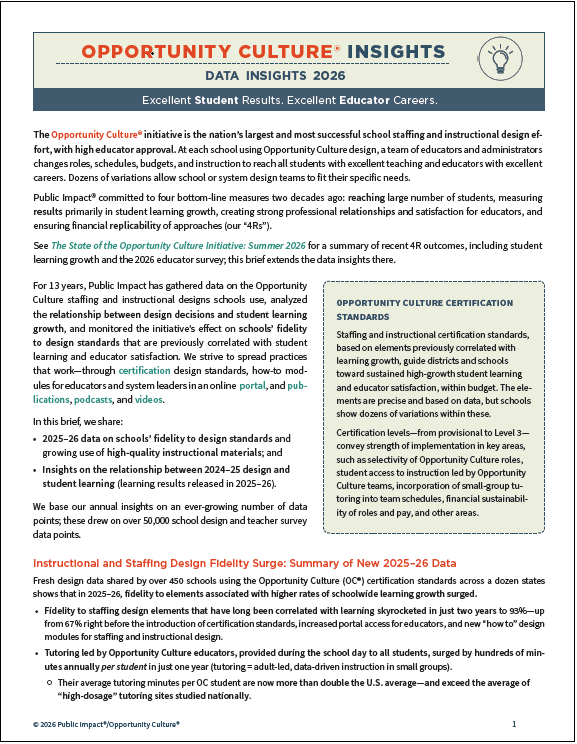
Reporting on progress toward our 4Rs and our insights from the most recent data analysis and annual educator survey, we see that following data-driven design standards—and giving educators access to how-to tools in an online portal—led to surges in schools’ and systems’ use of design elements correlated with high-growth learning outcomes, such as tutoring, along with nation-leading educator satisfaction. In addition, recommended-but-not-required elements, like adopting high-quality instructional materials (HQIM), are rising, too.
We see, for example, that tutoring led by Opportunity Culture® educators, provided during the school day to all students, surged by hundreds of minutes annually per student in just one year—so that the average tutoring minutes per student are now more than double the U.S. average—and exceed the average of “high-dosage” tutoring sites studied nationally.
In many other key elements correlated with higher-growth learning—such as financial sustainability of higher pay for Opportunity Culture® educators, selectivity for the Multi-Classroom Leader® role (choosing teachers who previously produced high-growth student learning), and reaching many more students with MCL™ educators roles in a core subject—fidelity also rose.
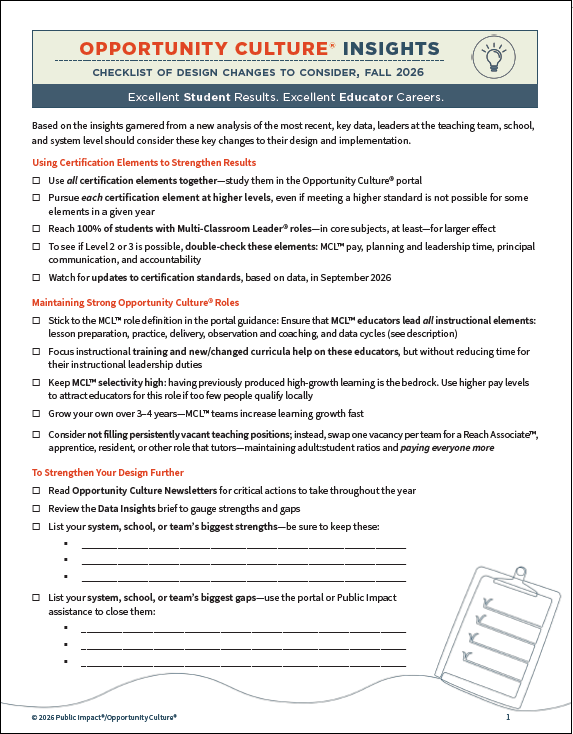
These briefs provide insights that all education leaders can use, and will help Opportunity Culture® educators and system leaders strengthen their designs.