
Reach, results, relationships, and replicability: Public Impact® staffers can recite these words in our sleep. Those are the big categories in which we measure our progress annually, using over 50,000 design data points from Opportunity Culture® sites nationally—including survey responses from 3,500+ educators in 2026.
This year, we’re pleased to report big strides toward our goals and the biggest insights that we’re using to further hone guidance and tools for schools, systems, and states–read on for a few highlights, and get the full details in our latest briefs.
Read our latest two-page briefs:
State of the Opportunity Culture Initiative: Summer 2026
Opportunity Culture Staffing and Instructional Design
Reach: Opportunity Culture (OC®) educators reached over 325,000 students in 2025–26, a 27% year-over-year increase. This doesn’t include students in the same schools but not in OC classrooms—but they benefit, too.
Results: Nearly an extra half-year of student learning annually, and schools were two to three times as likely to make schoolwide high growth when using data-driven design standards to plan and execute excellent instruction.
Relationships: Nearly all OC teachers—98%—agreed that OC models boost instructional excellence. OC teachers are 50% more likely to strongly recommend teaching compared with teachers nationally. Principals received high marks from staff for supporting instructional roles, too—read on.
Replicability: 98.6% of schools sustainably funded extra pay for educators with recurring money. Public Impact and generous partners invested to streamline and reduce implementation costs, too.
State of the Opportunity Culture Initiative: Summer 2026
The Opportunity Culture initiative is the nation’s largest and most successful school staffing and instructional design effort. Educators redesign their schools and instruction to reach all students with excellent teaching and more educators with excellent careers.
What is OC design? Schools select teachers who have already produced high-growth student learning for Multi-Classroom Leader® (MCL™) roles. They lead instruction for a small team, for more pay, within budget, including:
- planning and delivery of curricula, lessons, and methods;
- aligned whole-class, small-group, and individual instruction;
- teacher practice and coaching—using the curriculum and lessons being taught to students; and
- data-driven instructional cycles to differentiate for high-growth learning—up to and beyond grade level.
Team teachers, paraprofessionals, and apprentices may extend their reach, and many earn more, too. All adults tutor, and all students get tutoring. Schedules protect school-day time for each role’s duties. Accountability matches each role.
Public Impact envisioned Opportunity Culture design in 2006, published the first of many research and policy briefs in 2009, and launched with schools in 2013–14. Opportunity Culture teams serve mostly Title I schools so far but lift learning and job satisfaction broadly.
Read more: Opportunity Culture Staffing and Instructional Design
More Top-Line Results
| REACH >100 school systems in 18 states have used OC design in first 13 years 1,300 schools implementing, planning, or committed to use OC design >460 certified schools 2025–26—meeting data-driven design standards or having a plan to do so | ||
| RESULTS Nearly extra half-year of student learning annually, according to third-party research covering 4 districts, 3 states, 7 different years, >15,000 students, >180,000 comparison students Schoolwide high growth is twice as likely when schools met design standards vs. same-state schools without OC design; three times as likely if they reached 100% of students with the MCL role, according to our annual analysis covering ~75,000–200,000 students (numbers differ by comparison element) | ||
| RELATIONSHIPS—from 2026 survey of >3,500 educators out of >10,500 in OC roles nationally Teachers were 50% more likely to strongly recommend teaching than all U.S. teachers* 99% of MCL educators, and >90% of all OC educators, want OC models to continue in their school >$150 million extra pay cumulatively since 2013. Team leader pay supplement has averaged >20% of base, up to $25,000. OC educators are over 4X more satisfied with time to do their jobs than U.S. teachers** *Compared to 2025 E4E survey ratings of 9 and 10, the most recent available at time of publication. **Compared to national Pew survey 2025. | ||
| REPLICABILITY 98.6% of schools sustainably funded extra pay for educators with recurring money ↓~70%: Decreased cost per student over five years |
Read more: State of the Opportunity Culture Initiative: Summer 2026
Insights from 2026 Annual Educator Survey
In its 11th year, the Opportunity Culture Educator Survey is one of the nation’s largest annual multi-state teacher surveys, with 3,500 educators from 26 school systems responding out of >10,500. Some highlights from the survey:
- Nearly all educators in Opportunity Culture roles—more than 90% overall, and 99% of team leaders—want OC staffing models to stay in their schools, and nearly all agreed or strongly agreed that the models provided strong instructional support (93–99% on multiple indicators).
- Principals are excelling in leading OC instructional roles: 95% of MCL educators agreed that the principal (and/or AP) supported their success in their OC roles; 89% in all OC roles agreed. These perceptions help dispel the myth that most principals “aren’t ready” to lead strong instructional leaders and staff.
Opportunities for improvement suggested by survey results include communication by principals, protection of time for OC roles, and including more educators in OC roles. Still, OC educators rate their jobs far above other U.S. teachers’ ratings on similar measures of time and communication.
Insights from Annual Data Analysis
In the first half of 2026, for the 13th year, we analyzed the relationship between school design details and schoolwide student learning growth with over 50,000 data points. Our technical design team is using the findings to edit certification design standards and materials that guide schools toward improved results, to be released in fall 2026. All data are used exclusively to help schools and educators serve students. (See the schools that achieved certification status this year.)
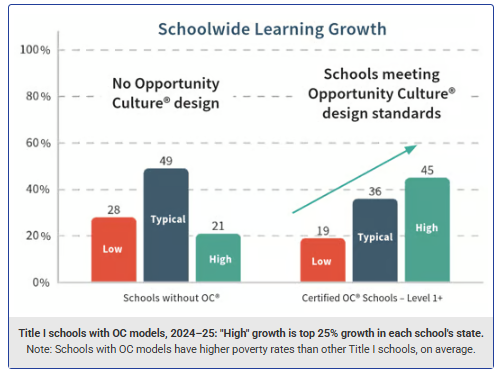
2024–25 data came from 15 states and 580 implementing schools with data, representing more than 200,000 students in OC classrooms. Along with the 2X–3X schoolwide growth results we saw, other factors associated with higher rates of schoolwide growth included:
- Meeting all certification standards at any level more than doubled high growth schoolwide.
- Meeting each design standard was associated with schoolwide learning growth—except one pay measure consistently related to job satisfaction.
- Reaching 100% of students with MCL roles tripled schoolwide high-growth rates.
- Title I schools with teachers who earn more for larger student loads/classes were nearly twice as likely to make high growth schoolwide as schools without OC models; nearly all included MCL roles, too.
- Schools trading classroom vacancies, rather than filling them all or hiring subs, boosted schoolwide high growth about 7 percentage points per trade, on average, above schools without 1 FTE classroom trade. Savings can fund higher pay for remaining educators.
Learn more: Join a free info session!