
With 15 years of experience designing and helping schools use Opportunity Culture® staffing and instructional design, we have learned many of the keys to long-term success for students and educators. Our new two-page brief details the essential elements leaders should heed to expand the success dozens of districts are seeing across the U.S.
Based on the five Opportunity Culture® principles first used in schools in 2012, and certification standards that build on the principles, the brief highlights critical elements to achieve results, reach, educator satisfaction, financial sustainability, and more.
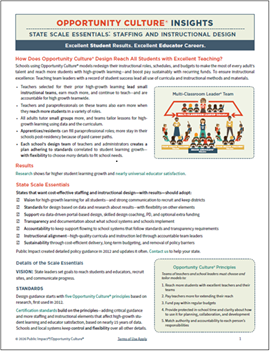
States that want cost-effective staffing and instructional design—with results—should adopt:
- Vision for high-growth learning for all students—and strong communication to recruit and keep districts
- Standards for design based on data and research about results—with flexibility on other elements
- Support via data-driven portal-based design, skilled design coaching, PD, and optional extra funding
- Transparency and documentation about what school systems and schools implement
- Accountability to keep support flowing to school systems that follow standards and transparency requirements
- Instructional alignment, with high-quality curricula and instruction led through accountable team leaders
- Sustainability through cost-efficient delivery, long-term budgeting, and removal of policy barriers
Public Impact® also created detailed state policy guidance in 2012, which we update and tailor to fit each location.
This is a companion brief in our package on the state of the Opportunity Culture® initiative, which shows that following data-driven design standards—and giving educators access to how-to tools in an online portal—led to surges in schools’ and systems’ use of design elements correlated with high-growth learning outcomes, such as tutoring, along with nation-leading educator satisfaction. In addition, recommended-but-not-required elements, like adopting high-quality instructional materials (HQIM), have risen.
Those surges came in a year when Opportunity Culture educators reached 70,000 more students, a 27% year-over-year increase.
Read, listen, and watch the highlights in the flipbook below, then see the package for an overview of Opportunity Culture® design, details on the latest stats and results, data insights with actions educators and system leaders can take, and this new state policy brief.