
High-Quality Instructional Materials
How Opportunity Culture® Teams Support HQIM Use
In Opportunity Culture® staffing and instructional design, teacher-led teams become the conduit for districts to introduce and strengthen teachers’ use of high-quality instructional materials, or HQIM, and the methods for using those materials well. Districts using Opportunity Culture® design retain full local control over all curriculum and are not required to use HQIM. But 2026 data shows they increasingly do, with elementary usage exceeding other U.S. schools in math and reading:
94% of districts using Opportunity Culture® design had adopted EdReports.org-approved HQIM in at least one subject at varying grade levels.
75% of these districts are using HQIM curricula in elementary reading, and 69% in math, compared to 64% and 65% in reading and math in large U.S. districts. Districts using Opportunity Culture® design range from the very smallest to top 20 in size, with average size lower than this national dataset; HQIM adoption rates may be lower in a more comparable sample of districts.
In addition, as systems plan their use of Opportunity Culture® design, nearly all district design teams now include a leader from both academics and human resources, creating departmental alignment that allows instructional team leaders (the Multi-Classroom Leader® role) to lead curriculum and instructional changes seamlessly.
High-Quality Instructional Materials
HQIM—engaging classroom materials that are aligned with state standards, based on evidence of higher student learning outcomes, and differentiation-ready—help set teachers and students up for success.
High-standard
Materials and methods are aligned with relevant state and national academic standards to ensure that students learn grade-level expectations through challenging content and tasks that promote critical thinking.
Differentiation-ready
Materials and methods address varied learning needs determined by student data. This includes aligned materials for prerequisite skills and knowledge, on-grade-level lessons, and advanced content for use in individual, small-group, and whole-class instruction, that allows every student to make high growth up to—and well beyond—standards. We do not recommend remediation that uses only prior-grade lessons; prerequisite skills should be taught in order to access content that is on grade-level or higher.
Engaging
Materials and methods are easy for teachers and students to use, with clear instructions, organized content, and editable resources that enhance instruction, promote a sense of belonging, and can be easily edited to engage specific students.
Research-backed
Materials and methods include tools to improve lessons and teaching, aligned assessments with options to track progress, research-based pedagogy for all grades and subjects, and curriculum-specific pedagogy tailored to content areas, when relevant.
HQIM Use Supports Multi-Classroom Leader® Teams
Using HQIM supports MCL™ team leaders in setting high standards for both learning outcomes and teaching methods.
Research* shows significantly greater positive impact on student achievement when teachers receive training, collaboration opportunities, and ongoing support directly related to HQIM implementation, which they can get through MCL™ teams.
Using HQIM bolsters small-group teaching and tutoring through differentiated materials, and provides a foundation on which further differentiation can be built.
Using HQIM saves team leaders and their teams time by enabling rapid editing of materials to engage specific students, rather than creating lessons from scratch.
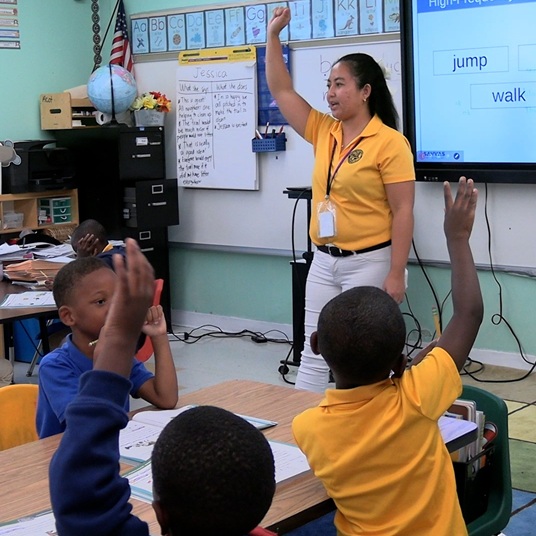
MCL™ Lourdes Acot teaches first grade at Wright Elementary School in Madison Parish, Louisiana
Identifying HQIM to Use
Public Impact® recommends using EdReports.org to identify HQIM that have higher standards and incorporate critical thinking skills, though not all are differentiation-ready or include advanced content. Teachers and schools using Opportunity Culture® designs, which on average produce higher student learning growth consistently, may, when they need advanced content for students to achieve high growth, use materials from the next grade(s) or course up in the same curriculum.
To implement HQIM well, MCL™ teams and their leaders may refer to the Instructional Practice Guide.