
Madison Parish School District
District Spotlight: Combining HQIM and Opportunity Culture® Staffing Design
DISTRICT AT A GLANCE
Location: Tallulah, LA
Enrollment (2025): 1133
Schools (2025): 4
Source: National Center for Education Statistics
In the Madison Parish School District in northeastern Louisiana, district leaders were ready for innovative ways to help the persistently low-performing system. The small, rural district, in which nearly all of its 1,300 students are eligible for free or reduced-price lunch, competes with nearby Monroe for teaching talent, and struggled to retain strong teachers and address its instructional needs.
In 2020, Charlie Butler returned to his hometown of Tallulah to become Madison’s superintendent, and with K–12 Supervisor Lucille Lovette and other district and school leaders, he embraced the concept of Opportunity Culture® teaching teams.
Through a state “instructional coherence cohort,” intended to provide extensive, targeted support, the district was able to combine the support these teaching teams provide with a focus on high-quality instructional materials (HQIM) to address longstanding issues—and quickly started to see progress for students and educators.
“Particularly struggling schools, they feel overwhelmed by all the needs that they have and that they have to address everything…diluting the experience for the staff, for the students,” said Jesse Unkel, who led the instructional coherence cohort for the state and helped the district home in on HQIM implementation. “When we helped them to really narrow the focus of their supports, the number of their supports that they were providing, it increased the quality of it. … and whenever you do take away everything else, that reduces really the mental and cognitive load of not only the teachers who might have to be juggling a bunch of things, but the students as well, because now there’s a more coherent learning experience for them.”
Hear more from the district’s leaders about their work with the state on Opportunity Culture® Audio:
For Louisiana District, HQIM + Opportunity Culture® Teams Sparks Early Wins
To strengthen the foundation for students, the district started with Opportunity Culture® design in its elementary and middle schools. Madison Middle, Tallulah Elementary, and Wright Elementary began design in 2023, using their new teaching teams in 2024–25.
Although the district had master teacher roles in the past, they took great teachers out of the classroom entirely, Lovette said. To avoid that, Madison Parish schools used the partial-release version of the Multi-Classroom Leader® (MCL™) role, so that team leaders can teach their own students for part of the day, with scheduled, protected time to go into their team teachers’ classrooms to provide coaching and feedback, and to lead team planning and data analysis. The district also used the Reach Associate™ (RA™) role to support the teams and assist with the district’s focus on small-group tutoring.
Literacy Leaps in Elementary School
At Tallulah Elementary, Principal Kimberly Pittman wanted to extend the reach of her best teachers while developing them as teacher-leaders, along with gaining consistent instructional practices and creating the support and career paths needed to retain teachers.
“We’ve been able to provide more job-embedded support for our teachers, and definitely more targeted high-dosage tutoring,” Pittman said.
Getting teacher buy-in was the biggest challenge initially, she said. Being very transparent about the purpose and communicating consistently helped. So did having student learning data conversations that focused on solutions, not blame, as instruction became a shared responsibility.
“The biggest change was that instruction was no longer isolated to individual classrooms,” she said.
With MCL™ guidance on instructional strategies, lesson plans, and student grouping, along with high-dosage tutoring and daily small-group time for at least an hour for math and literacy each—all centered on high-quality instructional materials—“teachers no longer feel like they’re on an island by themselves. We’re always there to support them,” she said. “Traditionally, our evaluation process was kind-of seen as an ‘I got you.’ And so this has totally changed the game in terms of support for our teachers and having someone there to work with you, alongside you, to co-teach with you, co-plan with you, whatever the need is.”
Superintendent Butler has seen how that support helped all the implementing schools.
“All superintendents, all school districts face lower retention. I think that this helps with retention,” he said. “All districts look at areas to improve morale. It helps with overall morale. “
I think that this helps with retention.”
—Charlie Butler, Superintendent
“
An international teacher from the Philippines, Lourdes Acot, who had taken on leadership roles each year since arriving in 2019, took the first-grade MCL™ role at Tallulah. She also saw the shift in teachers.
“We’re always talking our problems out. We talk about our issues together, so how do we need to solve this?” she said. “This is the important thing that we are doing, communication. Because if you don’t have it, it’s really difficult if you don’t understand each other. You’re not on the same page. So you need to talk it out. If you have some problems, relate to me so that we can find solutions to those problems. So I think that being supported is one of the big factors why they are inspired.”
A focus on student data was new to Acot as well as to her team. Realizing that data “is the real deal” and speaks volumes about their students, she embraced the challenge of moving students from very low starting points in literacy through intensive progress monitoring every week.
As part of that effort, she especially enjoyed getting to introduce a tutoring culture and its “small for all” theme.
“Before, we always used to have whole-group instruction,” with 25-plus students at a time, she said. “So sometimes the kids are demotivated if you are always doing that.”
Breaking into instructional groups of five respects students’ needs, she said.
“Sometimes those visual learners cannot really understand if you don’t provide picture cues or picture cards. Hands-on kids need to build, like, more hands-on activity, tactile skills. So by that, having differentiated instruction by doing small-for-all groupings, it really helps because you’re being intentional—what this group of kids needs, what this group of kids are lacking, and what you as a teacher need to know.”
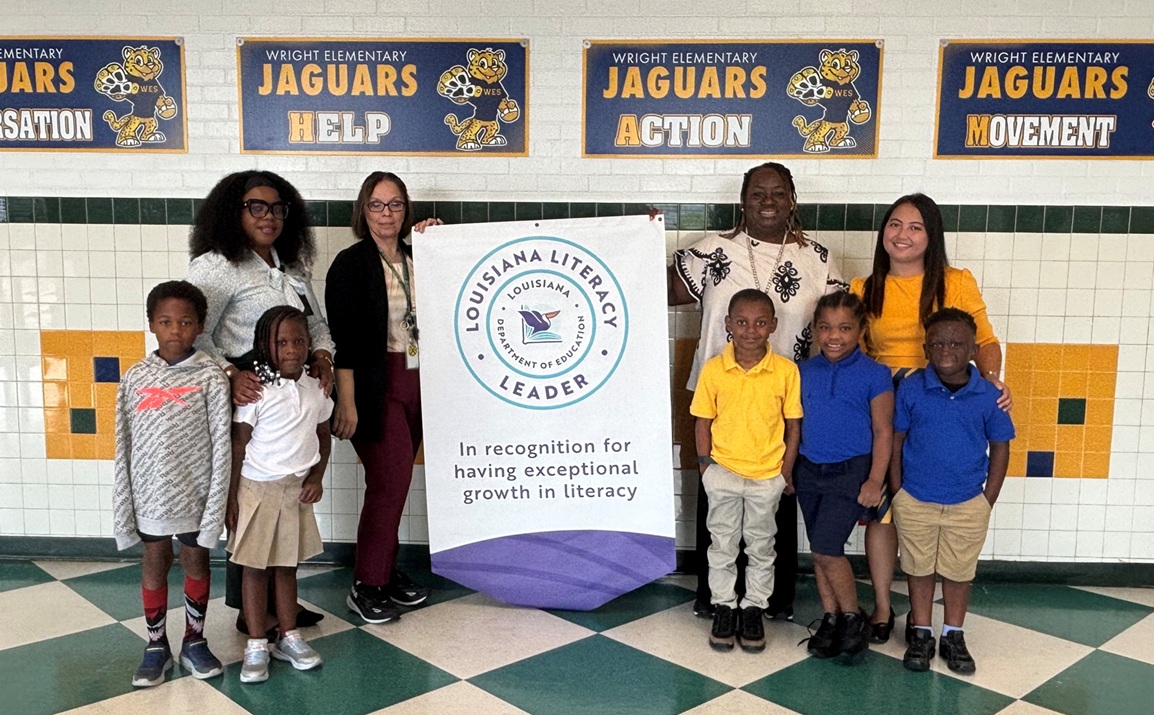
Principal Kimberly Pittman (back row, second from right) with staff and students at Tallulah Elementary School.
Using MCL™ teams helped Tallulah Elementary see improvements in student learning growth, teacher collaboration, and instructional consistency, along with better teacher retention and a more positive school culture, she said.
In summer 2025, the Louisiana Department of Education recognized the school as a “Louisiana Literacy Leader” for its exceptional growth in literacy.
The district improved its percentage of K–3 students testing at or above benchmark on the DIBELS literacy screener by 30.7%, placing it in the top three school systems across the state.
“That was really our main focus, trying to get our students to read, and to read across the curriculum, and to give them those strong foundational skills that will help them as they matriculate on through school. And so we were recognized for that effort,” Pittman said. “That has always been my prayer… because for so long, when I came into the district, it was all about it being at the bottom of the Louisiana state list…we are going in the right direction.”
At the start of the 2025–26 year, the district closed Tallulah Elementary and merged its students and staff with Wright Elementary, moving Pittman to lead Wright, with four MCL™ teams: K and first grade which Acot now led, a second-grade team, and one third- through fifth-grade team for math and another for ELA.
In the district’s second year of implementation, first-grade teachers took note of how much stronger students were at the beginning of the year than in previous years, because they had been taught by an MCL™ team in kindergarten, Acot said.
Now, Pittman said, Wright Elementary’s use of Opportunity Culture® teams was leading to learning growth, stronger progress monitoring, and more focus on the targeted interventions she said were crucial given that many students were below grade level in the upper grades.
“When implemented with clarity, support, and commitment, it works,” Pittman said. “It allows you to extend the reach of your excellent teachers, to develop strong teacher-leaders, to improve your instructional consistency and to accelerate student learning. It must be implemented as a true instructional improvement strategy, not just a structural change…. You could have structures in place and nothing is happening—you have to focus on the school improvement part, so you have to look at everything, from schedules, tutoring, instructional minutes, lesson planning—it’s a whole school improvement change.”
Introducing Small-Group Tutoring in Middle School
Perry Revels, now principal of Madison High School, was principal of Madison Middle for two years, when the district began its design process. The middle school, like the elementary schools, needed much stronger instruction, he said, making the state cohort and MCL™ teams a good fit.
One key to improvement, Revels said, was fidelity to the model, such as ensuring that team leaders had protected time for planning and coaching, and using RA™ time wisely to carry on instruction during MCL™ coaching time.
Although it felt a bit unnerving at first to leave paraprofessionals in charge of a classroom, he said, “they’ve been doing exceptionally well with providing instruction and support. But it takes a lot of planning and collaborating.”
Throughout the district, educators expressed strong support for how much the RA™ role contributes to stronger instruction, especially by making more small-group time possible and allowing team leaders to leave the classroom to coach their team teachers without a gap in instructional delivery. It has become a coveted position, Lovette said.
“They are providing that differentiated instruction…students become more confident. It creates a safe space for productive struggle, for learning, for growth,” Pittman said. “That has helped a lot with our lower and middle-performing students who get to experience that. I wish I could have an RA for every classroom.”
Revels said the RA™ role quickly became highly sought-after because it so directly affected student learning, unlike typical paraprofessional roles, and was leading to several becoming full teachers.
“That is a good pipeline for growing your own teachers, especially being in rural northeast Louisiana where it’s difficult to attract teachers,” he said.
[The RA™ role] is a good pipeline for growing your own teachers, especially being in rural northeast Louisiana where it’s difficult to attract teachers.”
—Perry Revels, Principal, Madison High School,
“
Madison Middle Assistant Principal Alecia Tyndale came to the middle school just as it began using MCL™ teams, beginning with ELA and social studies; the school added a math MCL™ team in the second year of implementation.
“Teachers who were demotivated, they are now motivated, because they realize that they have someone in their corner to actually coach them, to actually lean upon when they have struggling moments,” Tyndale said. “Also, our students love those classes, especially when we have small-group instruction.”
MCL™ team teachers feel safe, she said, asking their leader for advice, and appreciate seeing new strategies tested first in an MCL™ class before they get rolled out to the team—a prime benefit of the partial-release role, creating more credibility with team teachers.
Tyndale championed small-group tutoring, and was thrilled with the difference it made.
Students get teacher and RA™ small-group instruction within their classes and through MCL™ pull-outs—in ELA and social studies during the first year of implementation, and now math, with the addition of an MCL™ math team in 2025–26. Before Opportunity Culture® implementation, the school did not use small-group instruction.
“That was one of the main things that we were lacking, and it was Opportunity Culture who allowed us to see that that was what was lacking. Because when we started having small-group instruction in our classes, we actually see the students blooming. We actually see results in our data, because right now we’re more focused on our data,” Tyndale said. “We had students who were not able to read, who are now reading.”
With 25 years of teaching experience, most recently as a fifth-grade teacher, Rose Kinsey was ready for a new challenge when she joined Madison Middle in 2024–25 to lead its first MCL™ team—a challenge made somewhat easier because she had taught the incoming sixth-graders, with whom she had gotten very strong learning results.
The shift to small groups, Kinsey said, created a more relaxed environment for students, such as during their independent work time while other students are with a teacher.
“So it’s not just like structure, structure, but it’s an environment that the kids will want to do the work. ‘Can I sit over here? Can I sit over there?’ ‘As long as you’re doing your work, it’s fine’—that’s a buy-in for the children,” Kinsey said. “I think if we buy them into it, we will see growth.”
Small-group instruction also pushes students to take more responsibility for their learning, while feeling more comfortable and participating more than in whole-class time, Tyndale said.
And regular data days help students see their progress toward their goals—and where they are falling short—and connect that to the personalized help they get in small groups from their teacher, team leader, and paraprofessional.
The sense of warmth that the tutoring culture created spurred students to begin reading more, Tyndale said.
“They’re actually reading on their own. They’re taking up a book. Before [MCL™ teams], you will not really find students in the class taking up a book to read,” she said. “They might be stumbling on a word. You will see them actually come up asking, ‘What is this word? Could you help me pronounce this word?’ And just that alone actually shows how interested the students are in their own learning.”
The personal attention also made a difference in student attendance, Tyndale said.
“I believe that it has improved because the students are more comfortable in their learning. They realize that adults are there that really cares, and because of that, they’re open. They are so enthused about learning, they just want to know more,” she said.
As the assistant principal focused on curriculum and instruction, Tyndale also appreciates how she can coach the team leaders, knowing that they will spread new strategies throughout their teams.
Creating a partial-release MCL™ schedule was an initial challenge, she said, until they divided the day between MCL™ time teaching directly in the mornings and reserving the afternoons for other small-group instruction, co-teaching, planning, and coaching team teachers. It helped to understand that co-teaching or coaching could happen successfully during just part of a class period, leaving time for planning without overburdening the team leader.
And the partial-release role means that teachers who are not on an MCL™ team can also observe the team leaders in action, modeling what instruction should look like—affecting schoolwide results, she said.
In the first year of implementation, Tyndale said, the school, which had about 240 students, saw more than 30 students reaching mastery in ELA, with 10 at the advanced level—where previously they had none at advanced, and far fewer at mastery.
Creating Community-Wide Effects
As parents and teachers start to share more about student learning growth, and see the effect on teacher retention, the effects ripple through the community, Kinsey she said.
“Sometimes schools get a bad rap…but even our school has shown growth. So the community talks about that. So, they’ll say, OK, the school is trying, the school is making a difference,” Kinsey said. “And that’s how the community grows, because if we can grow children, think about how the communities can change. Think about how things can get better in the communities. And then it spreads from the community, it spreads all out into the nation.”
More districts should take advantage of the different Opportunity Culture® design can make, Lovette said.
“If there’s any way you want to improve your school, your community, use OC, because it’s going to improve your teaching and learning,” she said. “It’s going to change your instructional focus within the school. It’s going to give you more colleagues collaborating with each other, working, communicating,” she said. “At the district level, it forces us to communicate more with our colleagues, along with our team, as well as with the district leader.
“Who’s going to win in the end? Our scholars will win. Not only will our scholars, but our communities, our schools—and our communities change. When you have a good school, the people in your community are so proud of it.”