
Students Reached in 2025–26
Educators on Teams in 2025–26
$ Total Extra Pay Since 2013
Extra Months of Annual Learning, Nearly Extra Half-Year, on Average
% Team Leader Approval on Anonymous, Annual Survey
% Average Team Leader Stipend For More Than a Decade
In the first 13 years of Opportunity Culture® school redesign, over 100 districts and charter organizations in 18 U.S. states changed roles, teams, pay, budgets, and schedules to reach more students with excellent teaching and more educators with excellent careers.
sites
The sites have included rural and urban school districts and charter school networks, ranging from systems with just one school to some of the nation’s largest.

In 2025–26, more than 1,300 schools were implementing or planning Opportunity Culture® designs, or committed by their districts or states to use them in coming years. More than 88% of schools using the designs were eligible for Title I funding.
schools
At the end of 2023–24, Public Impact® introduced certification levels using design standards based on 10+ years of data and research in key areas, including selectivity of Opportunity Culture® roles, the percentage of students with access to instruction led by Opportunity Culture® teams, incorporation of small-group tutoring by the team, teacher-leader time to plan and lead, and financial sustainability of roles and pay. Certifications standards will continue to evolve based on data about results. See the list of schools with certification.

Over 325,000 students are being reached by one or more Opportunity Culture® teachers and their high-growth instruction in 2025–26 alone, in a combination of schools with certification and others that implemented their design before certification.
students
Opportunity Culture® teachers reach students across all four core subjects, at least, which may now include CTE courses designated as a core subject by their schools. Students may be reached in more than one subject; the count of “over 325,000” represents unduplicated student numbers.
Students reached, by subject, in 2024–25 (2025–26 figures coming this summer):
MATH
READING
SOCIAL STUDIES
SCIENCE
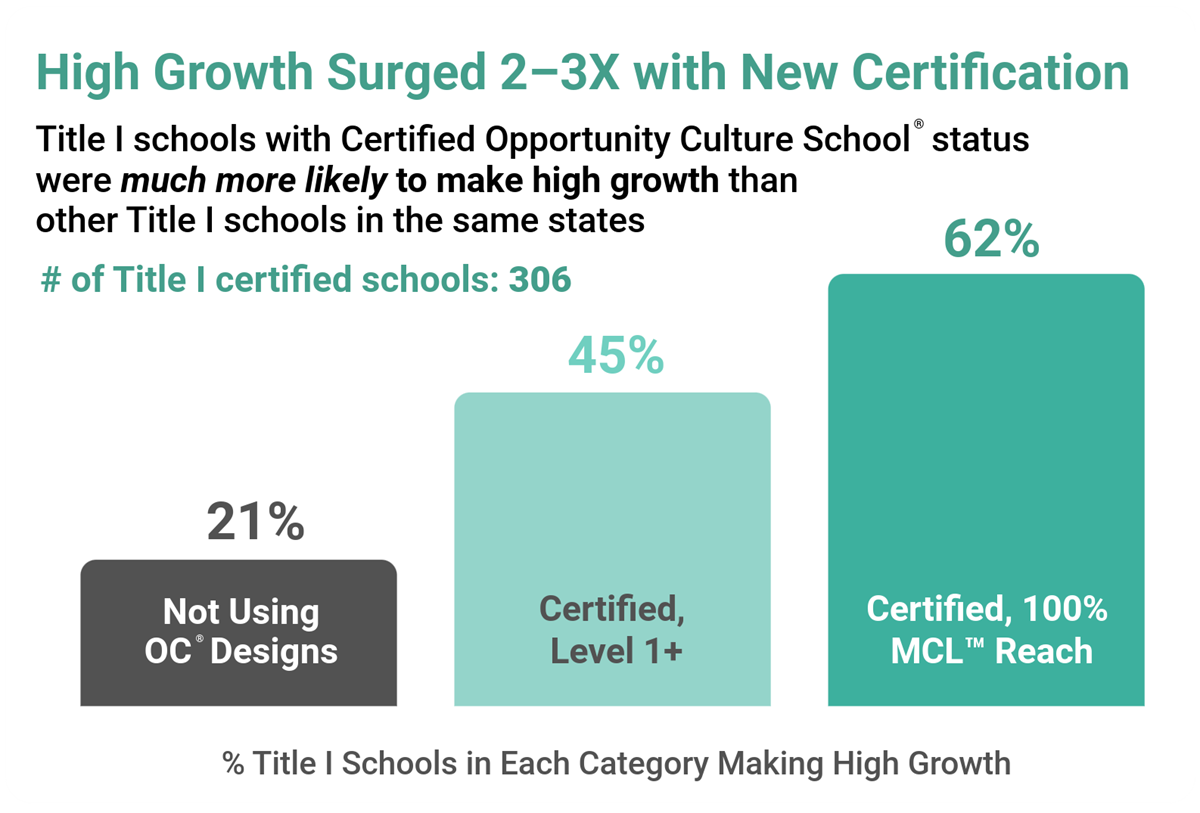
Schools see 2X rate of schoolwide high learning growth in reading and math combined with Opportunity Culture® designs that meet design standards, and 3X if reaching all students. High-growth rates rise with higher certification elements. Students have gained nearly an extra half-year of learning each year.*
growth
- Of the 206 schools with certification at Level 1 or higher, 52% exceeded growth targets, compared with 25% of all schools in their state without these staffing designs.
- Of the 160 Title I schools with certification at Level 1 or higher, 45% exceeded growth targets, compared with 21% of Title I schools in their state without these designs.
- 62% of schools with certification exceeded growth targets when reaching all students in at least one core subject, compared with 21% of Title I and 25% of all schools without these staffing designs.
The certified schools were also significantly less likely to fall short of growth expectations than comparable schools. See more about research here.
Over 10,500 educators in 2025–26 are in advanced, higher-paid Opportunity Culture® roles or are receiving on-the-job development on teaching teams.
EDUCATORS
Before 2017–18, schools planning Opportunity Culture® designs used a variety of roles to extend teachers’ reach. All schools implementing since 2018 use Multi-Classroom Leader® roles, with a variety of team structures and other roles on their teams.
Educators serving in team roles in 2024–25:
MCL™ Role
TRT™/MTRT™ Roles
RA™ Role
Team Teacher
From the initiative launch in 2013 through 2025–26, more than $150 million have been reallocated to higher educator pay—now tens of millions more each year.
pay
In 2025–26, the average Multi-Classroom Leader® supplement was over 20% of average pay.
$ Maximum OC® Supplement
$ Average MCL™ Supplement
Educators express strong satisfaction with their roles. 97–99% of educators in the Multi-Classroom Leader® role consistently report wanting these roles to continue in their schools, according to anonymous survey results through 2025.
survey
More than 90% of educators in all Opportunity Culture® roles have wanted the roles to continue in recent years, and say the support they receive improves their instruction.
In a 2025 survey, more than 90% of educators in all Opportunity Culture® roles agreed that:
- Teachers are held to high professional standards for delivering instruction 98%
- Teachers receive feedback that can help them improve teaching 95%
- The supports provided translate into improved instructional practice 95%
- Excellent teachers in my school have opportunities to lead peers 94%
*Growth notes:
In third-party studies, in combined reading and math among students directly taught by MCL™ roles or their team teachers, students gained an extra 2–13 months of learning above comparable students each year, or an average of nearly an extra half-year. Schoolwide growth effects cited above are important, too, because MCL™ teams, principals, and district leaders have reported that they share methods and materials outside of their teams, and in some cases with other schools in the same district.