
The Opportunity Culture® Results
Strong student learning growth and educator satisfaction with higher educator pay
Redesigned roles let teachers with prior high-growth learning transform instruction schoolwide, which has led to over a dozen years of student learning growth and educator-pleasing results:
Student learning growth
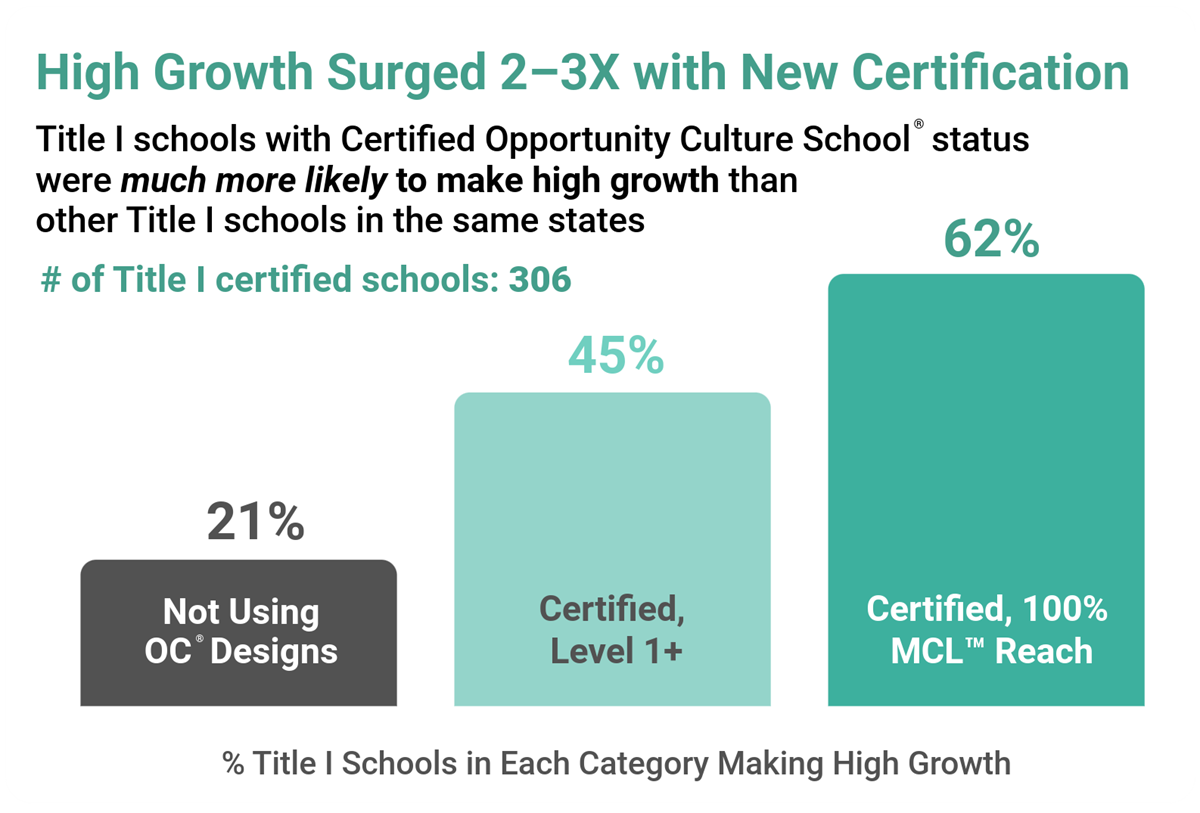
Nearly an extra half-year, every year, on average—according to third-party research. Schools are twice as likely to make schoolwide high-growth learning when meeting the first level of certification standards, and three times as likely when reaching all students.
Educator satisfaction
Surveys show educators love their small teams, led by teachers with a record of high-growth learning, and the advanced roles within the models.
Higher pay for educators
Multi-Classroom Leader® (MCL™) pay supplements are, on average, equal to 20% of typical salaries, and MCL™ team teachers and paraprofessionals can earn more, too.
Build-your-own teacher pipeline
Teams can include paid, full-time, yearlong residencies for aspiring teachers.
School and district certification
Gaining certified status can attract applicants and families looking for excellent schools.
Cost-effective
District design time and costs have been significantly reduced through the addition of the Opportunity Culture® portal and other innovations; portal access gives all educators annually updated design, professional learning, and teaching tools—to sustain learning results and pay long-term, at a low cost.
Opportunity Culture® Spotlights
Carlsbad, NM: How schools got state-leading results—including highest growth in the literacy proficiency rate, 4th-highest in math.
Ector County, TX: How redesign helped teacher turnover rate drop from 18% to 1% and lead to learning gains
Schools Get Results
Students gain nearly an extra half-year of learning each year, on average, when an educator in the Multi-Classroom Leader® role with prior high growth leads a teaching team with a variety of team role options. The odds of a teacher helping students make high-growth learning more than double when on these teams.
Teacher-led teams also make it possible to create a tutoring culture, giving all students access to more small-group teaching and tutoring during the school day to further boost learning, aligned with core curricula.
Schools meeting design standards and obtaining Certified Opportunity Culture School® status were two to three times more likely to exceed learning growth expectations schoolwide than schools not using Opportunity Culture® staffing designs, according to publicly available school growth and school certification data.
Educators express strong satisfaction with their roles
97–99% of educators in the Multi-Classroom Leader® role consistently report wanting these roles to continue in their schools, according to data from a decade of annual, anonymous surveys.
Over multiple years, more than 90% of educators in the MCL™ role have agreed that:
- Teachers in my school have opportunities to lead peers 90+%
- The supports provided translate into improved instructional practice 90+%
- Teachers receive feedback that can help them improve teaching 90+%
- Teachers are held to high professional standards for delivering instruction 90+%
Students 2025–26
reached by excellent teachers and their teams in 2025–26 alone
Educators 2025–26
have advanced roles or receive on-the-job development on teams in 2025–26
Total $ Extra Pay
allocated to Opportunity Culture® educators since 2013
Everyone Benefits
Districts and schools using these models also describe the improvement they see in educator recruitment and retention since beginning implementation, and improving educator pipelines through advanced paraprofessional and teacher resident roles.
When students learn more, they can ultimately get better jobs and earn more. Using McKinsey’s method for calculation,* students in classrooms using these team models will earn over $100,000 more in their careers, on average.
Students earning more boosts local economies fast. The more schools that adopt the models, the bigger the local boost.
And the more schools statewide using these models, the bigger the boost to the state’s economy. Again using McKinsey’s math, in an average state, implementing these models statewide in three-fourths of schools—even with lower results than third-party studies have found—would add $6 billion to $10 billion to the economy over 16 years, if three-fourths of schools make the transition rapidly. Increased tax revenues could be used to pay teachers more and meet other priorities.
* McKinsey & Co. (2009). The Economic Impact of the Achievement Gap in America’s Schools; or see our more conservative estimate applied to one state
Opportunity Culture® Stats
See more about the effect of these models in action.
Third-Party Research
Learn what third-party studies show about student outcomes.
Get Started
Ready to make a difference for your students?
We saw an improvement in their outcomes immediately last year in terms of growth of students…and we saw an increase in the number of teachers who outperform the state in terms of growth of students.
—North Carolina superintendent
“