
Nationally, hundreds of Title I schools using Opportunity Culture® staffing design were two to three times more likely to achieve high-growth learning in 2024–25 than Title I schools in the same states not using these designs–outcomes exceeding other national strategic staffing efforts. What would it take for school systems everywhere to see the same results?
A big part of the answer lies in the hands of state policymakers. In the latest issue of State Education Standard, the journal of the National Association of State Boards of Education, Sharon Kebschull Barrett and Bryan C. Hassel of Public Impact® provide three key steps policymakers should take to support all of their districts in redesigning for student success and educator satisfaction.
As Barrett and Hassel noted, over more than a dozen years so far, Public Impact® has helped hundreds of schools in 18 states, including many in rural and semirural areas and low-income neighborhoods, to create designs that defied the odds, substantially improving learning and boosting educator job satisfaction within limited budgets.
Opportunity Culture® data and research show that these designs are producing nation-leading outcomes—more extra months of learning per year than other strategic staffing models, consistently high educator satisfaction, and average team leader supplements of $13K, and as high as $25K.
And the districts have stories to tell, from large, urban districts such as the 144,000-student Charlotte-Mecklenburg Schools to more than a dozen districts with fewer than 10,000 students. In fact, half of the districts using Opportunity Culture® staffing design have fewer than 15 schools. This staffing design, with its blend of flexibility + fidelity to proven design standards, can work in districts throughout a state.
“Opportunity Culture is the closest thing to a silver bullet that I’ve seen in my career.”—Carlsbad Municipal Schools Superintendent Gerry Washburn
In districts using Opportunity Culture® design…
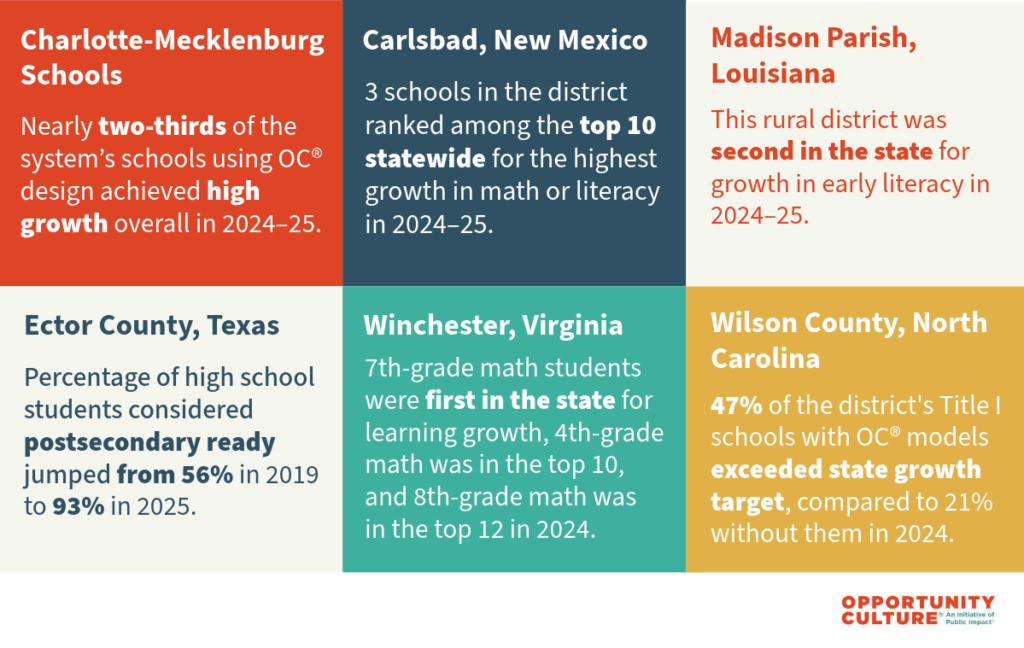
So, Barrett and Hassel write, in a time of declining enrollments, tight budgets, and disappointing gains in student learning, state boards can support districts’ school redesign efforts. They describe three key steps:
- committing to data-driven results,
- catalyzing change through transition funding and removal of policy barriers, and
- continuing the monitoring and support needed to reach all students.
Read the article: Achieving Results through School Redesign: Five principles guide staffing design, and state leaders have three tasks
Learn more: Info for state and district leaders