
In October 2025, Public Impact® reported on North Carolina high-growth results for schools; now, we’re pleased to share new findings from national data: Schools using updated Opportunity Culture® staffing design standards achieved, on average, two to three times the rate of schoolwide high-growth learning of other schools in the same states in 2024–25.
In addition, new third-party research in one district found a full extra half-year of learning in reading and more than an extra third of a year in math for students between 2020 and 2024. Prior third-party research on three districts found more than an extra half-year of learning in math.
The staffing designs create teaching teams that reached over 275,000 students and 10,500 teachers in 2025–26 alone and are expanding in 18 states.
“Educators continue to help students learn far more in roles designed to support excellent instruction,” said Bryan C. Hassel, co-president of Public Impact®, which founded the Opportunity Culture® initiative. “We see variation based on adherence to design standards associated with stronger learning, and potentially due to other factors like curriculum focus. Most important, students are learning while educators are earning more.”
Opportunity Culture® staffing design affects both instruction and human resources by extending the reach of excellent teaching to more students, for more pay, within regular budgets—and with more time for team collaboration. Schools create Multi-Classroom Leader® teaching teams, which are led by a teacher with a record of high-growth student learning compared with others in the same state.
A team of teachers and administrators at each school determines the exact team design and instructional methods, which vary among sites. All schools now use design standards and materials based on data. Multi-Classroom Leader® teams may include other teachers who reach more students and advanced paraprofessionals who tutor, for more pay.
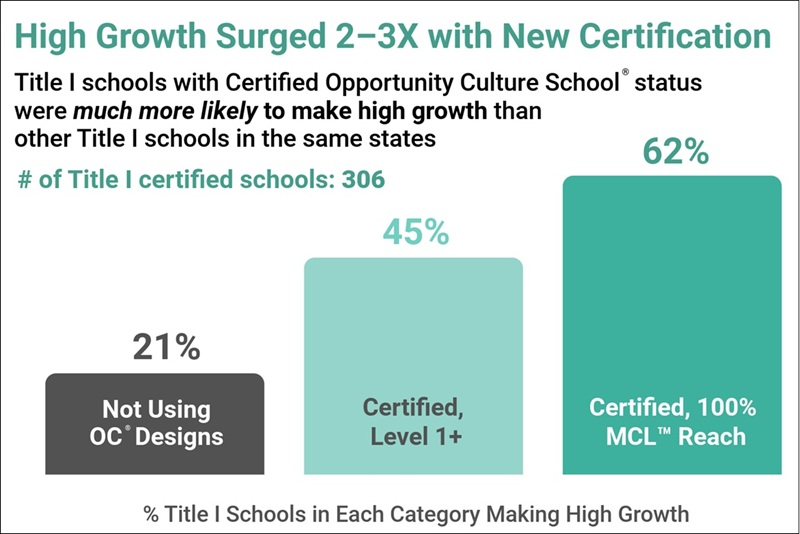
Two to three times the rate of schoolwide high-growth learning: According to publicly available data, high growth surged among certified schools in 2024–25, the first year that schools had access to new design standards all year and that educators had direct access to design and instructional tools online.
Among hundreds of schools, 45% of Title I schools attesting that they met Level 1 certification standards for Opportunity Culture® teams made high growth, compared with just 21% of Title I schools without the teams in the same states. Sixty-two percent produced high-growth learning schoolwide when they met the design standards and reached all of their students with the models. Increasing fidelity raised rates of high-growth learning even more.
Public Impact® correlated more than 50 design and implementation elements with schoolwide high-growth learning in hundreds of schools over more than a decade. Elements associated with high-growth schoolwide learning, or with higher satisfaction among educators, were included in the standards required for Certified Opportunity Culture School® status, though schools retain wide latitude to adopt additional design elements.
Schoolwide results varied by state. For example, North Carolina schools reached more students per school and were more likely to adhere to design standards. Texas schools reached fewer students per school and were less likely to adhere to data-driven standards, despite strong educator teams in many schools.
“Together, we and other researchers can illuminate what works, but only legislators and governors can give educators widespread access to design and instructional tools and ensure transparency about which districts and schools are reaching students with what works,” Hassel said.
Nearly an extra half-year of learning, on average: In 2013–16 and 2020–24: Students taught by teachers on Opportunity Culture® (OC®) teams gained nearly an extra half-year of learning growth in math and reading, on average, in two third-party studies of four districts covering seven years. The first study was conducted by AIR and Brookings for the CALDER Center and the second by Texas Tech University. Students in the same schools but not taught by these teams learned almost an extra month more by their third year, according to the second study, an effect called “spillover.” All schools in these studies went through Opportunity Culture® design based on research—but before the creation of certification standards using initiative data.
Nation’s largest staffing design initiative: In 2025–26, more than 10,500 educators were in Opportunity Culture® advanced roles or were part of Multi-Classroom Leader® (MCL™) teams. Since 2013, more than 100 sites in 18 states have used Opportunity Culture® staffing designs. The sites have included rural and urban school districts and charter school networks, ranging from systems with just one school to some of the nation’s largest. Over 1,150 schools are now implementing, creating, or planning to create their new staffing designs.
$120 million in educator pay supplements: From 2013, when the Opportunity Culture® initiative began, through the current school year, educators have received more than $120 million in pay supplements.
MCL™ pay supplements have averaged 20 percent or more of typical teacher pay since 2014. In 2024–25 (the latest data available), the average MCL™ pay supplement was $13,352, and went as high as $25,000.
Near-unanimous support for Opportunity Culture® roles: In annual, anonymous surveys, 97–99% of educators in the MCL™ role consistently report wanting these roles to continue in their schools, and more than 90 percent of educators in all team roles want them to continue.
See the Opportunity Culture® website for more statistics.
A McKinsey analysis indicates that learning results like these boost the economy substantially. This adds jobs and tax revenues to fund national, state, and local priorities. McKinsey included Opportunity Culture® models in its Covid learning recovery recommendations.
In addition to calling for states to provide access to and accountability for adoption of these designs, Public Impact has repeatedly called for higher base pay for teachers and adoption of stronger materials to save MCL™ teams time for all aspects of planning and delivering excellent instruction.